Explainable fraud verdicts in under 90 seconds.
FidelityAI turns claim documents, photos, voice statements, and policy evidence into a structured, defensible recommendation, approve, deny, or investigate, with a full audit trail behind every call.
Insurance fraud cost annually
Claims a single adjuster juggles
Typical manual review cycle
The manual review cycle lacks an audit trail, consistency, and speed.
Detection across every kind of claim evidence
Switch between the three signal families FidelityAI inspects. Each runs deterministic forensics first, then a calibrated model.
- Invoices, claim forms, and policy PDFs
- How the document was produced and edited
- Revision-history and structure anomalies
- Text-vs-document contradictions
Layered analysis inspects how a document was produced and changed over time, then a calibrated model issues an authenticity verdict with its reasoning.
Modern fraud has outgrown metadata-only checks
Fraud leaves a multi-modal pattern. Only coordinated agents can read documents, photos, voice, and policy history at the same time.
- Manual, sequential review
- Metadata-only authenticity checks
- Slow handoffs between teams
- Inconsistent, hard-to-defend calls
- Parallel multi-agent review
- Document, photo, voice, and policy forensics
- One evidence graph, one verdict
- Explainable recommendation with audit trail
How we review an insurance claim
Watch a claim move from evidence intake through multi-agent analysis to an explainable decision, the same pipeline that powers the product.
Conversational voice intake plus transparent reasoning
FidelityAI uniquely combines voice intake with a fully transparent, multi-agent reasoning architecture, not a black-box score.
| Voice intake | Full audit trail | <90s verdict | Open architecture | |
|---|---|---|---|---|
| FidelityAI | ||||
| Manual adjusters | ||||
| Legacy tools | ||||
| Generic LLM wrappers |
Dozens of specialized agents, one auditable decision
Dozens of specialized agents process, analyze, and evaluate the evidence, each writing a human-readable artifact, so every recommendation carries a full audit trail.
Built for the people who work claims
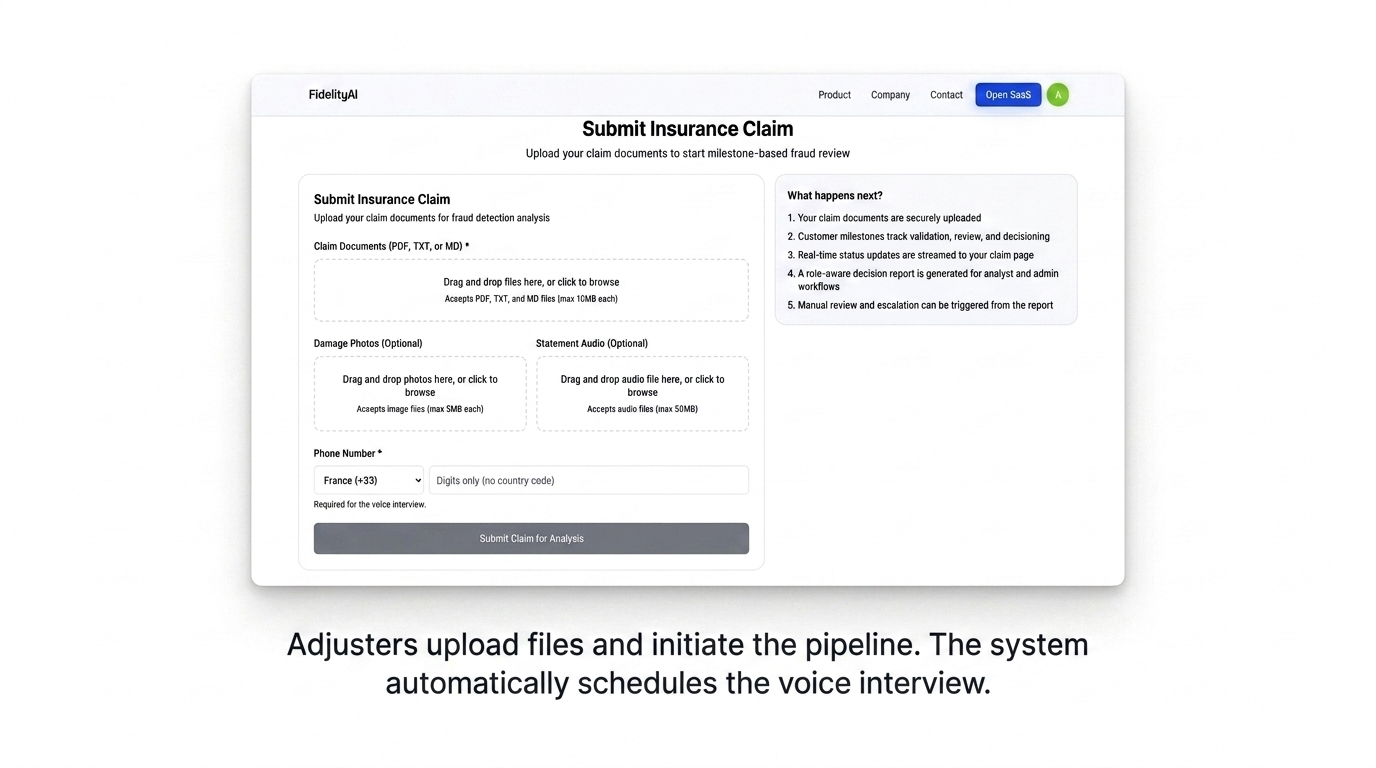
Guided evidence intake
Adjusters upload files and initiate the pipeline; the system automatically schedules the voice interview.
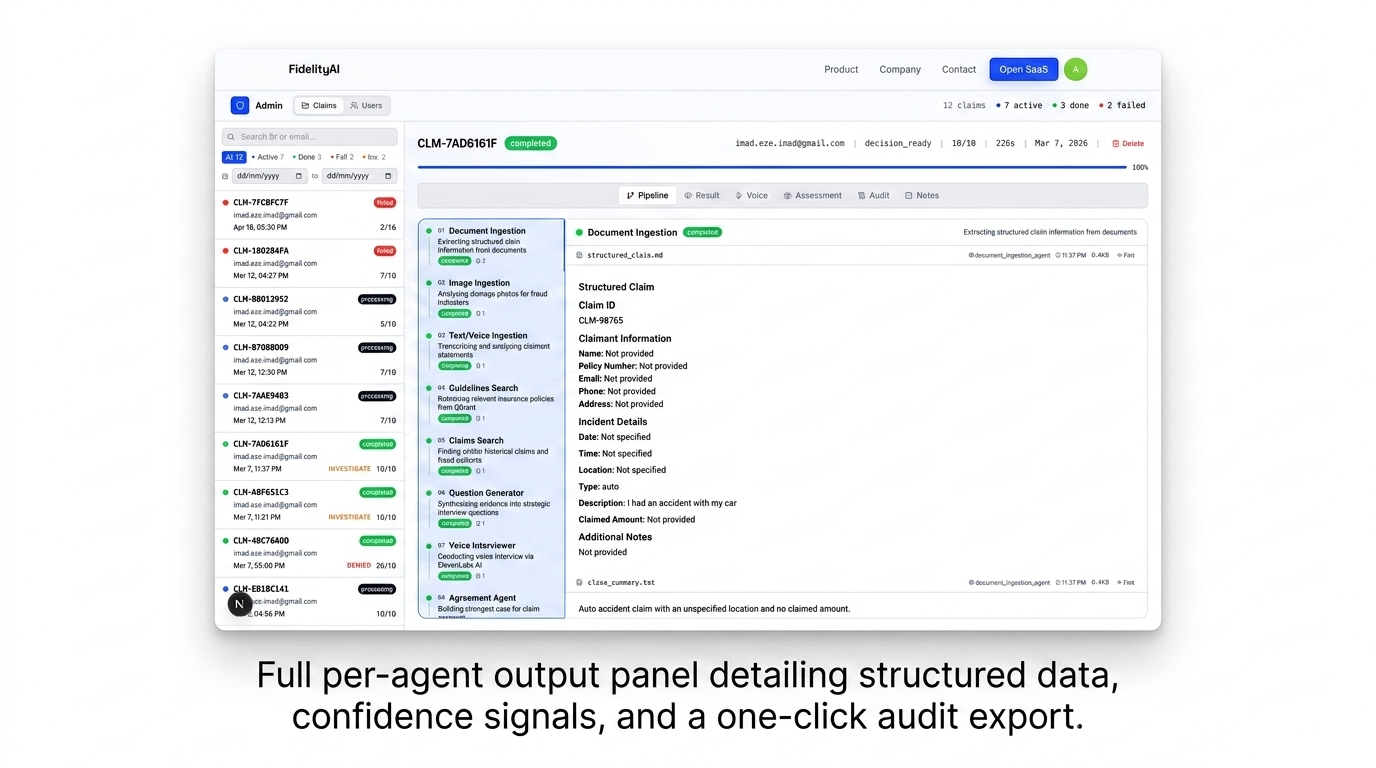
Per-agent output panel
Structured data, confidence signals, and a one-click audit export for every agent in the review.

Claimant milestone tracker
Real-time status updates build trust while drastically reducing inbound support calls.
Capability that turns into operational results
Faster triage without hiding evidence
Prioritize high-risk claims earlier while every signal stays visible and traceable for the adjuster.
Earlier fraud detection before payout
Document, photo, voice, and policy signals are cross-checked together, catching manipulation a single check misses.
Consistent, audit-ready decisions
Each stage writes a human-readable artifact, so approve / deny / investigate calls are defensible by design.
Enterprise controls built into the workflow
Tenant-scoped workflows
Every claim, artifact, and audit record is isolated per tenant.
Audit exports
One-click export of the full per-stage reasoning trail.
PII redaction controls
Sensitive fields are redacted before logging and export.
Artifact encryption
Stage outputs support encryption at rest.
Role-aware admin
Access to claims and audit logs follows assigned roles.
Run a claim review workspace on your own evidence
Submit claim documents, photos, and statements through the SaaS and see the full multi-agent decision with its audit trail.